

VINYL GYM FLOORING
Rolled Vinyl Gym Floors in NJ: Sheet Vinyl Gym Flooring
Since 2001 · 50,000+ projects completed
Durable, low-maintenance sheet vinyl gym floors with game lines for preschools, elementary schools, cafeteria-gyms and community centers across New Jersey.
Prefer to talk? Call 973-801-7219
2001
In business since
50,000+
Projects completed
K–12 → NBA
Schools to arenas
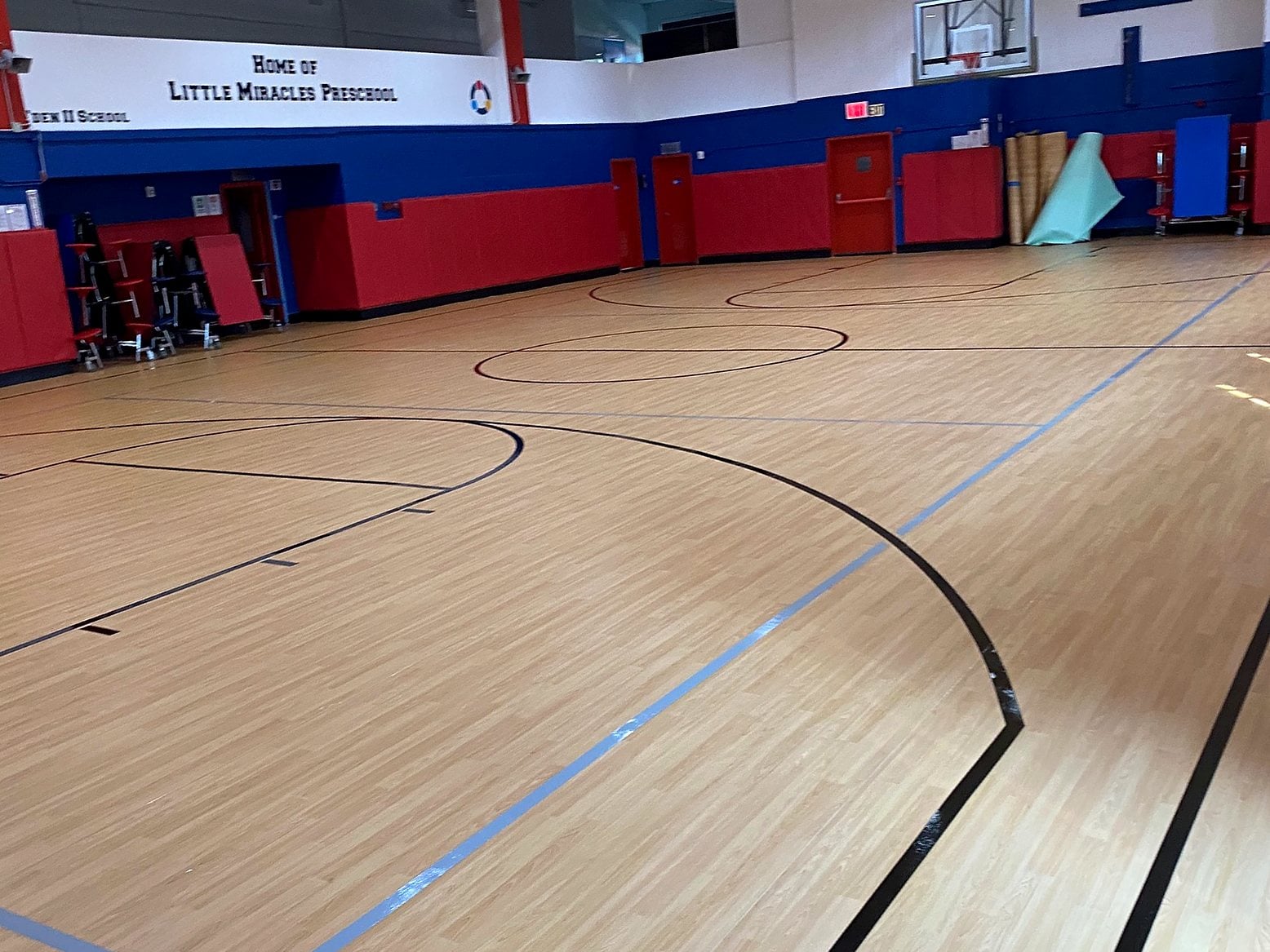
A rolled vinyl gym floor is a sheet vinyl sports surface that comes in wide rolls and is glued down over a concrete slab. It is tough, easy to clean and less costly than a new hardwood court, which makes it a good fit for preschools, elementary school multipurpose rooms, cafeteria and gym combos, and community centers. In New Jersey, a rolled vinyl gym floor typically costs about $15 to $20 per square foot installed, with subfloor prep quoted separately.
J & J Gym Floors installs rolled vinyl gym floors from our base in Wayne, NJ. This page explains what rolled vinyl is, where it works best, how it goes in, how to take care of it and how it compares with hardwood and poured floors.
What is a rolled vinyl gym floor?
Rolled vinyl (also called sheet vinyl) sports flooring is made in long, wide rolls instead of boards or tiles. The rolls are laid side by side, glued to the floor and the seams are sealed, so the finished floor is one smooth surface. Most products have a tough wear layer on top. Many also have a foam or cushioned backing underneath for comfort and some shock absorption.
The rolled vinyl system we prefer to install is Tarkett Omnisports. Tarkett makes it in several versions, including Omnisports Speed, Multi-Use, Active+ and PurePlay, rated for different levels of shock absorption under the ASTM F2772 sports floor standard. According to Tarkett, each sheet is built in layers: a factory-applied polyurethane surface treatment (TopClean XP), a vinyl wear layer, a printed design layer that can look like real wood, and a foam performance layer underneath for cushioning. Tarkett’s catalog lists Omnisports thicknesses from 3.45 mm (Speed) up to 9.4 mm (PurePlay). We help you pick the version that fits how your room is used.
Rolled vinyl comes in solid colors and in wood-look patterns that look like a maple court from the bleachers. Game lines for basketball, volleyball, pickleball or PE games are painted on, so the room works like a real gym.
Where rolled vinyl gym flooring works best
- Preschools and daycare centers. A cushioned vinyl floor is softer underfoot than bare concrete or tile, and spills wipe right up.
- Elementary school gyms and multipurpose rooms. PE class in the morning, assemblies after lunch, and a school event at night.
- Cafeteria and gym combos. Vinyl handles tables, chairs and food spills better than wood, and it can be mopped every day.
- Community centers, churches and recreation rooms. Open gym, fitness classes, meetings and parties on one floor.
For a varsity competition court that hosts high school or college basketball, we usually recommend a hardwood gym floor instead. We talk through which surface fits your room during the free site visit.
Benefits of a rolled vinyl gym floor
- Durable. The wear layer stands up to daily foot traffic, PE class and rolling tables and chairs.
- Low maintenance. No yearly sanding, screening or recoating like a wood floor. Regular sweeping and mopping keep it clean.
- Cushioned options. Products with a foam backing give more comfort and shock absorption than a hard floor.
- Lower cost than hardwood. A rolled vinyl gym floor usually costs less to install than a new wood athletic floor.
- Real game lines. Basketball, volleyball, pickleball and PE lines in your colors, so the room plays like a gym.
- Handles moisture and spills better than wood. Vinyl does not cup or swell from a spilled drink the way wood can.
How much does a rolled vinyl gym floor cost in NJ?
A rolled vinyl gym floor typically costs about $15 to $20 per square foot installed in New Jersey. That price includes:
- The vinyl flooring
- A basic set of game lines
- Vinyl cove base around the walls
- Thresholds at the doorways
It does not include subfloor prep. Every slab is different, so we look at yours at the free site visit and quote any prep it needs, such as leveling, patching or moisture work, as a separate line.
Where you land in the range depends on the size of the gym, the vinyl product you choose, and the condition of the subfloor and the prep it needs. These are typical ranges, not a quote. Every price depends on your floor, so we give you a free estimate after we see it.
How a rolled vinyl gym floor is installed over concrete
- Site visit and moisture testing. We check the concrete slab for moisture and flatness. Moisture coming up through a slab can loosen the glue and damage a vinyl floor, so we test before we order material. Relative humidity testing under ASTM F2170 is a common method.
- Subfloor prep. Old flooring and adhesive come up if needed. Cracks and low spots get patched or leveled so the vinyl lies flat.
- Layout and acclimation. The rolls sit in the room so they adjust to the building’s temperature before they go down.
- Glue down and seams. Each roll is glued to the slab with the adhesive the manufacturer specifies, and the seams are sealed so the floor is one surface.
- Cove base and thresholds. Vinyl cove base goes around the walls and thresholds go at the doorways for a clean finish.
- Game lines. We lay out and paint your lines in your colors.
Your exact steps and cure times depend on the product and the adhesive, so we follow the manufacturer’s instructions for each job.
Rolled vinyl gym floor maintenance
- Every day: dust mop or sweep to pick up grit, which wears the surface like sandpaper.
- As needed: damp mop with a neutral cleaner made for vinyl sports floors. Wipe up spills right away.
- Machine cleaning: ask us or the manufacturer which machine, pad and cleaner are safe for your product before you use one.
- Protect it: put walk-off mats at the doors, use floor protectors on chairs and tables, and use gym floor covers for big events.
Unlike wood, rolled vinyl does not need a yearly screen and recoat. Follow the manufacturer’s care guide for your product, since some vinyl sports floors need a special cleaner or finish.
Rolled vinyl vs. hardwood vs. poured sports floors
Rolled vinyl vs. hardwood
Hardwood maple is the top choice for competition basketball. It has the best ball bounce and can be sanded and refinished many times, but it costs more (about $17 to $25 per square foot installed in NJ) and needs a screen and recoat every year, as the MFMA recommends. Rolled vinyl costs less, handles spills and mixed use better, and needs less upkeep. Learn more about a new wood gym floor installation.
Rolled vinyl vs. poured or synthetic floors
A poured-in-place sports floor is mixed and poured on site, so it has no seams. It typically runs about $14 to $23 per square foot in NJ, depending on the system and thickness. Rolled vinyl comes ready-made in rolls, so the surface is made in a factory and goes down quickly once the slab is ready. See our rubber and synthetic gym floors for more options.
What about weight rooms?
Rolled vinyl is not the right floor under heavy free weights. For lifting areas we install weight room rubber flooring, which is built to take dropped weights.
Rolled vinyl gym floors in New Jersey and nearby
We are based at 77 Michael Drive in Wayne, NJ, and install rolled vinyl gym floors for schools, preschools, churches and community centers across New Jersey, including Bergen, Passaic, Morris, Essex and Hudson counties. We also work in New York, Pennsylvania and Connecticut.
Frequently asked questions
How much does a rolled vinyl gym floor cost?
In New Jersey, a rolled vinyl gym floor typically costs about $15 to $20 per square foot installed. That includes the vinyl, a basic set of game lines, vinyl cove base and thresholds. Subfloor prep is not included and is quoted separately after our free site visit. The price depends on the size of the gym, the vinyl product and the condition of the subfloor.
Can rolled vinyl go over our concrete floor?
Yes, rolled vinyl is usually glued directly to a concrete slab. The slab has to be dry, clean and flat, so we test it for moisture and check for cracks and low spots first. Any prep it needs is quoted as a separate line.
Is rolled vinyl a good floor for a preschool or elementary school gym?
Often, yes. A cushioned rolled vinyl floor is softer underfoot than tile or concrete, it handles spills and mixed use, and it is easy to clean. For a competition basketball court, hardwood is usually the better choice.
How do you clean a rolled vinyl gym floor?
Dust mop it daily and damp mop with a neutral cleaner made for vinyl sports floors. Check with us or the manufacturer before using any cleaning machine, pad or chemical, and follow the product’s care guide.
What brand of rolled vinyl gym floor do you install?
We prefer Tarkett Omnisports. It comes in several versions, from Omnisports Speed for light recreation to Multi-Use, Active+ and PurePlay, with more shock absorption for basketball, volleyball and PE. We help you choose the right one at the free site visit.
Can you paint game lines on a vinyl gym floor?
Yes. Basic game lines are included in our typical price, and we can add more sports or colors. We lay out the lines so your room works for PE, basketball, volleyball or pickleball.
Request a free estimate for your rolled vinyl gym floor
J & J Gym Floors has been in business since 2001, with more than 20 years of experience and more than 50,000 projects completed. Tell us about your room and we will set up a free site visit, check your slab and send a written estimate. Call 973-801-7219 or email john@gymfloors.com.
Or call J & J Gym Floors at (973) 801-7219, or email John at john@gymfloors.com
